
You’ve nailed pay.
The rest of reward,
benchmarked.
A benchmarking community for UK reward: pension, leave, family policy, health cover, incentives — everything except base pay. See where you stand, and hear when it moves.
Everything except base pay.
300+ metrics across eight areas, every figure with its sample size on it.
- Pay practice 59metricsSee all 59
- Governance & Transparency 57metricsSee all 57
- Time Off & Family 50metricsSee all 50
- Incentives & Recognition 44metricsSee all 44
- Benefits & Lifestyle 44metricsSee all 44
- Health & Protection 24metricsSee all 24
- Pensions & Savings 22metricsSee all 22
- Wellbeing 17metricsSee all 17
It starts with what you’re trying to do.
Four stages. The last one doesn’t stop.
-
Set the context
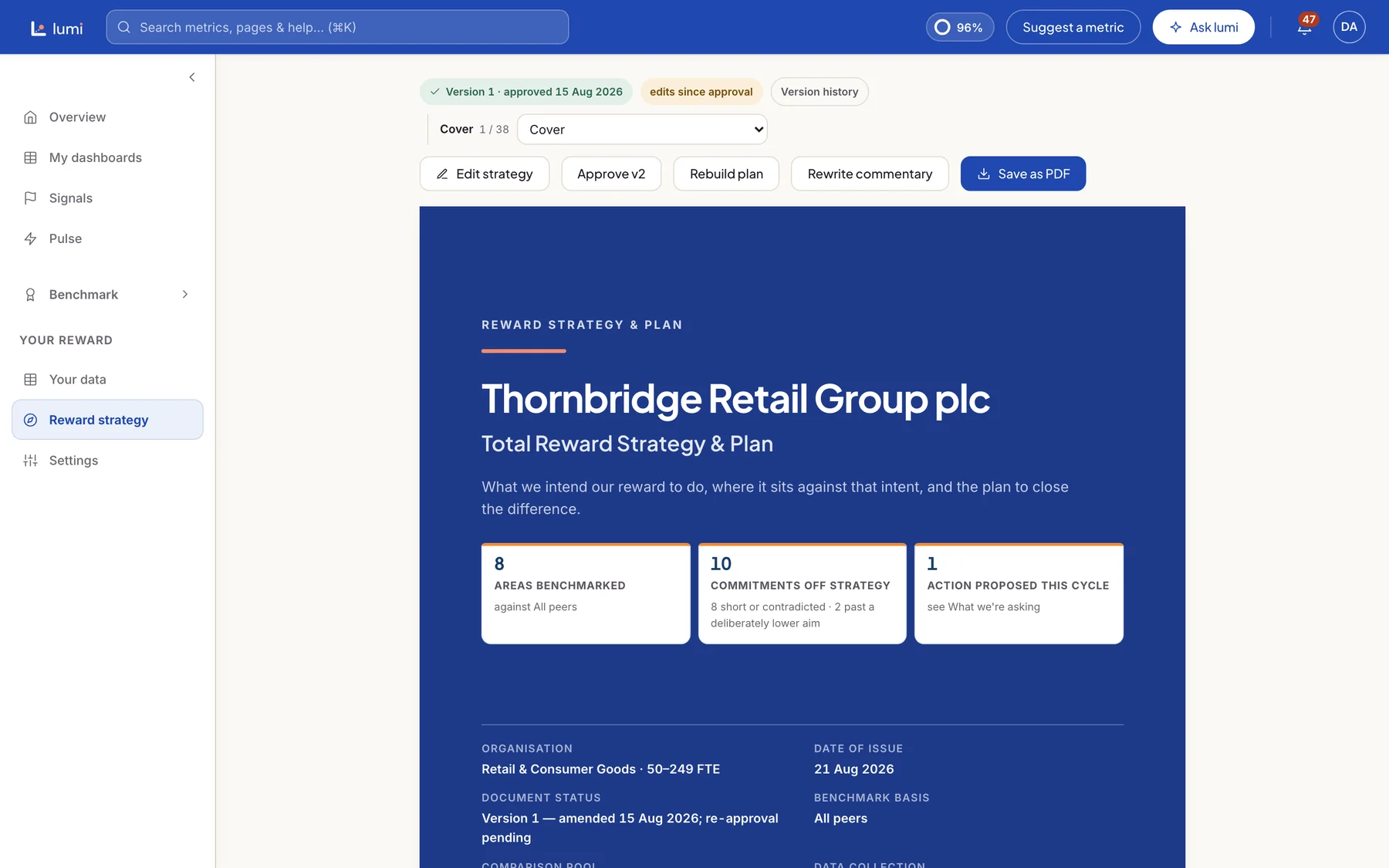
Who you are, and what reward is meant to do here: where you lead, where matching the market will do, and where you’ve quietly decided not to compete. No written strategy? Most don’t. Say where you want to sit and lumi measures against that. Then your practice: policies, not people. Your IT team reviews a questionnaire, not an integration.
-
Bring in the market
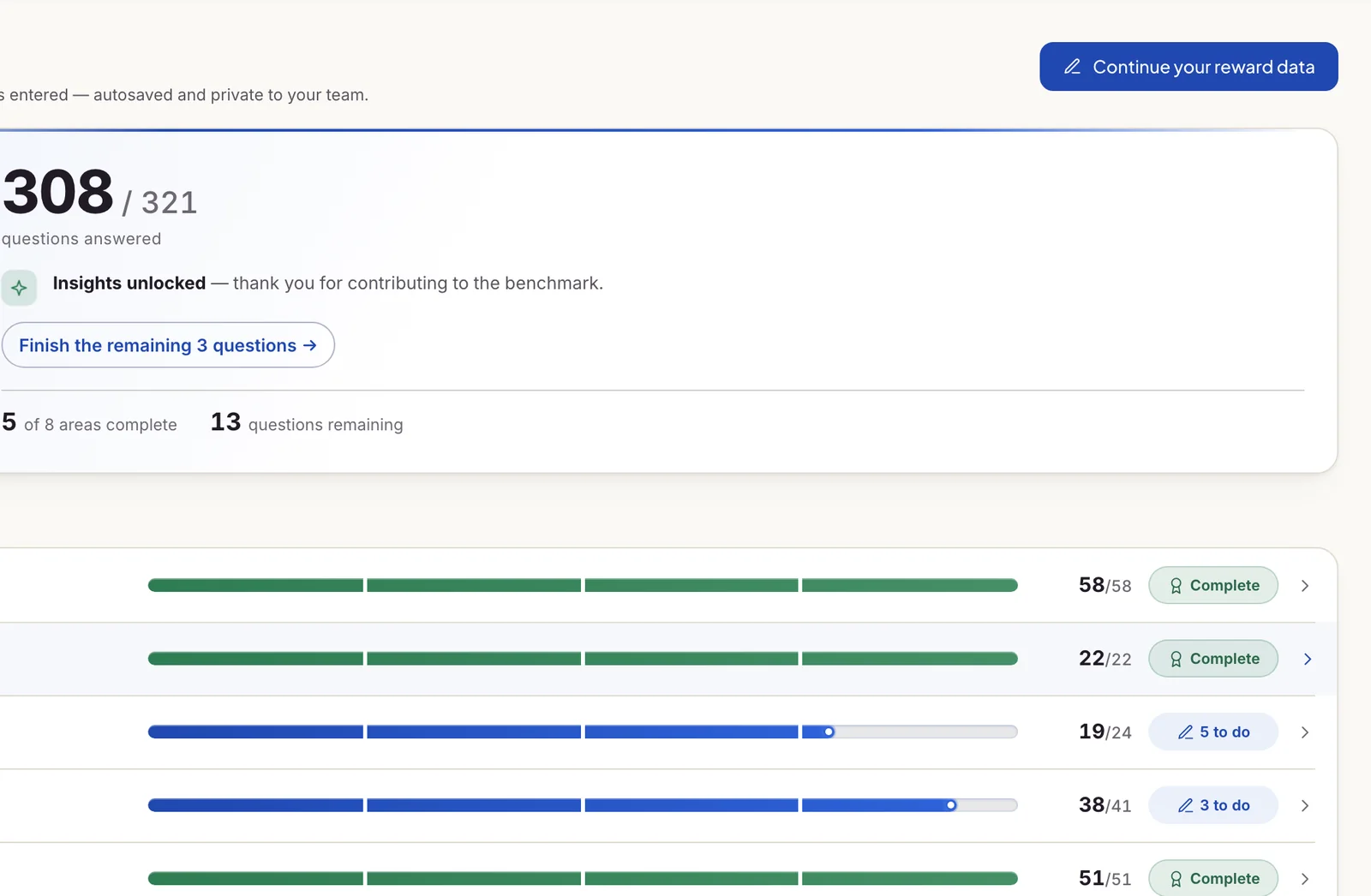
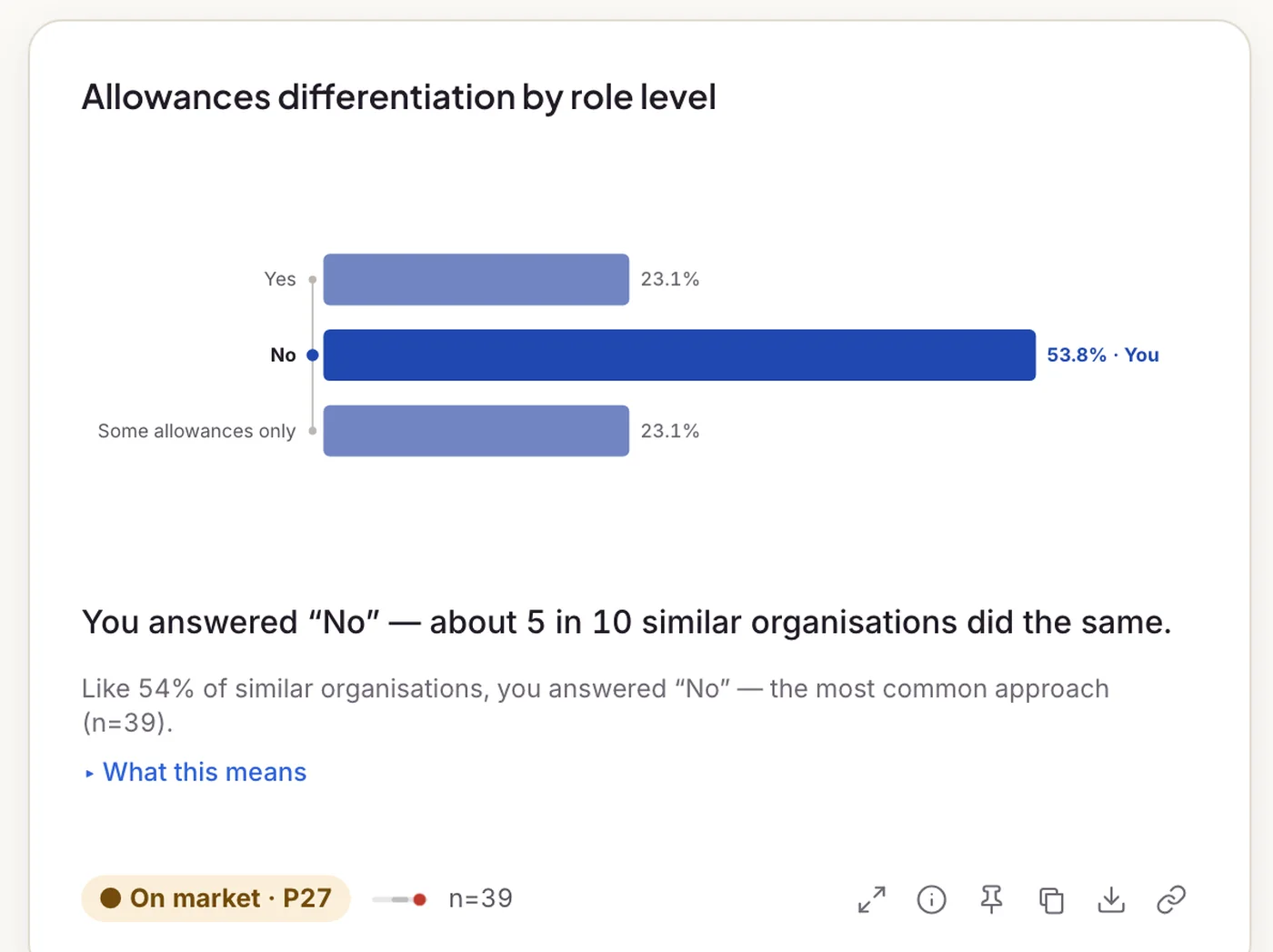
Your answers sit alongside 260+ UK organisations across 14 sectors. Sector and size set your starting peer group, and you can redraw it. Nothing shows unless at least five organisations sit behind it. Your first answer comes back with a comparison.
-
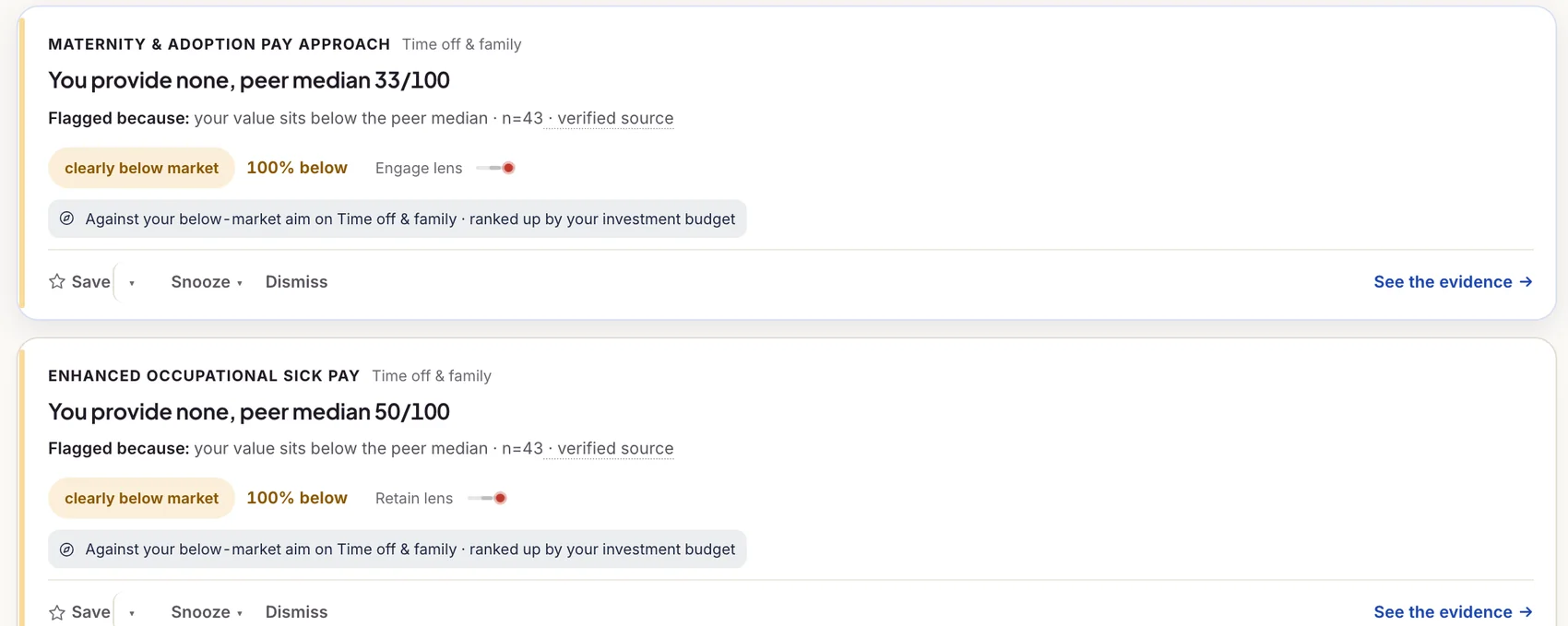
Read the signals
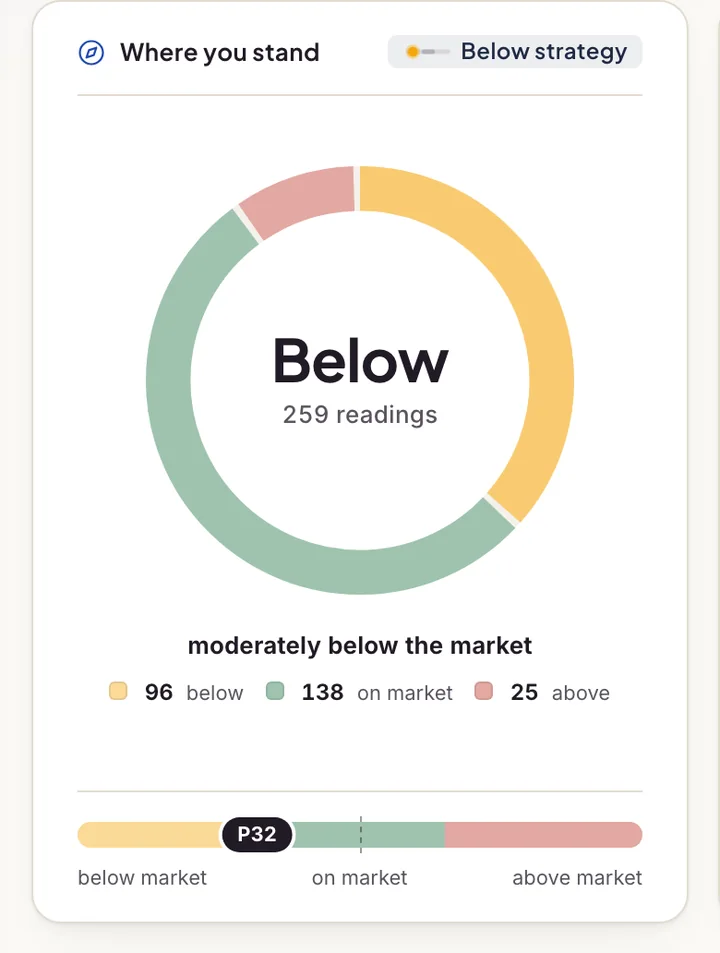
Every answer gets a read: below, on or above market, or how common your choice is. lumi sets that against the strategy you chose. Where you meant to sit below market, it says so and leaves you alone: a decision, not a gap. Where you’ve drifted somewhere you didn’t intend, that’s a signal. lumi flags; you decide.
-
Then it keeps watching
Change a policy and your position moves. Members join and update their answers, and the market moves too. lumi re-reads where you stand each time and emails you only when something shifts, either away from your strategy or back towards it. You don’t check it. It tells you.
And when you just need an answer.
The signals come to you. Everything else is there when you go looking.
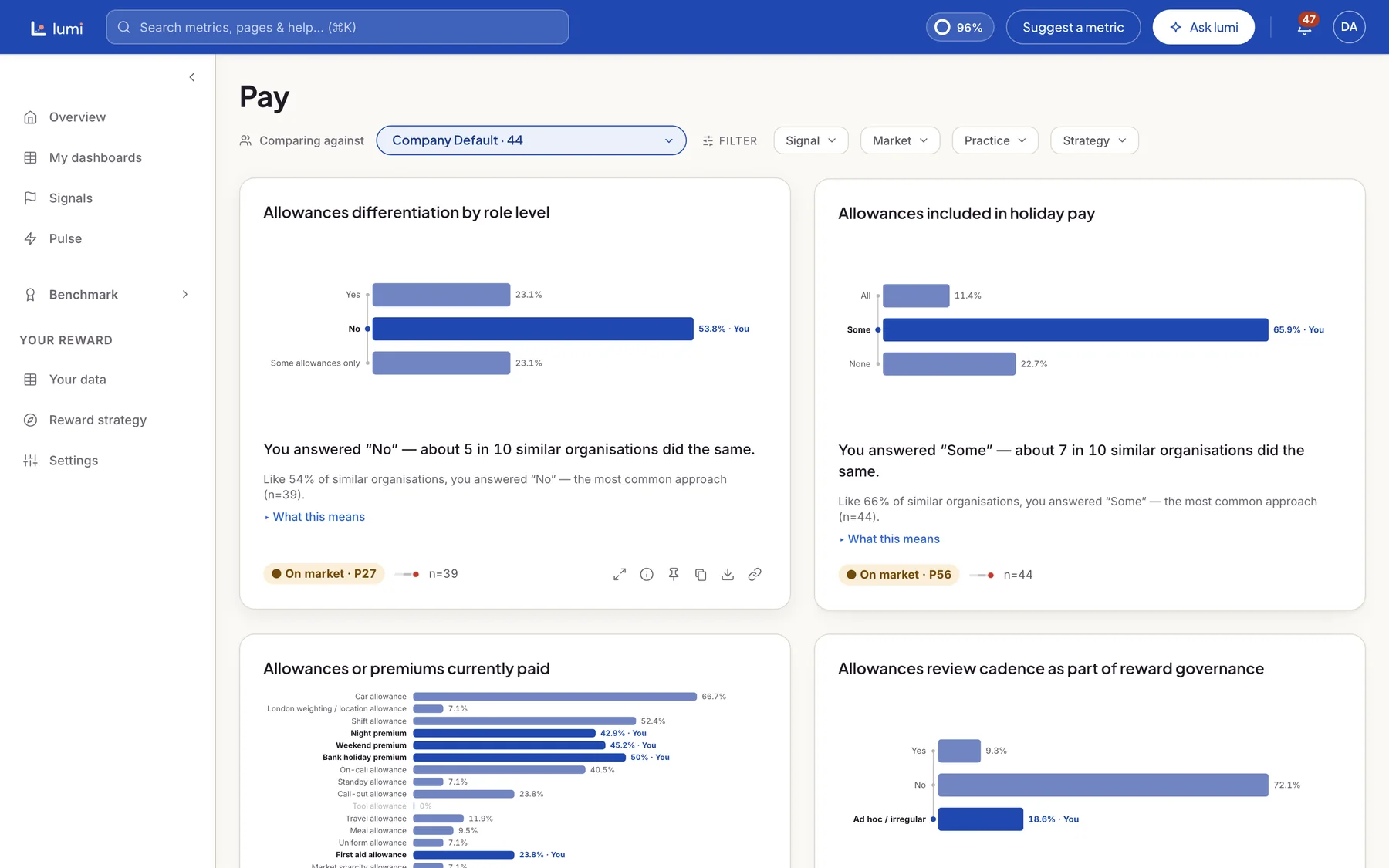
Benchmark one thing.
A CFO question, a policy up for review, an enhanced leave proposal that needs evidence. Pick the practice and the peers, and see the distribution and where you sit.
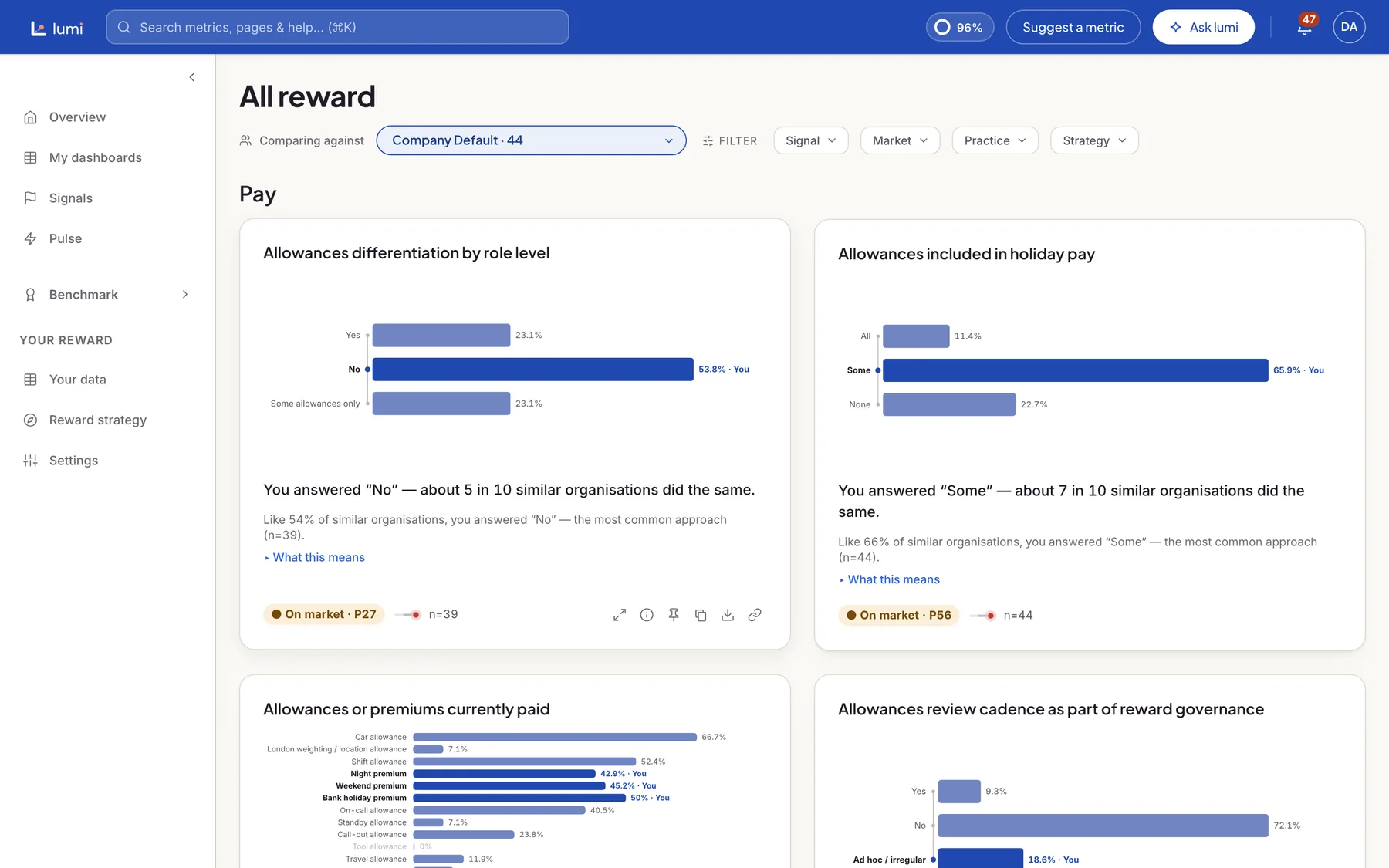
Build your own view.
The metrics your board or leadership team cares about, on one dashboard, cut by peers they’d recognise. Ready for the pack.
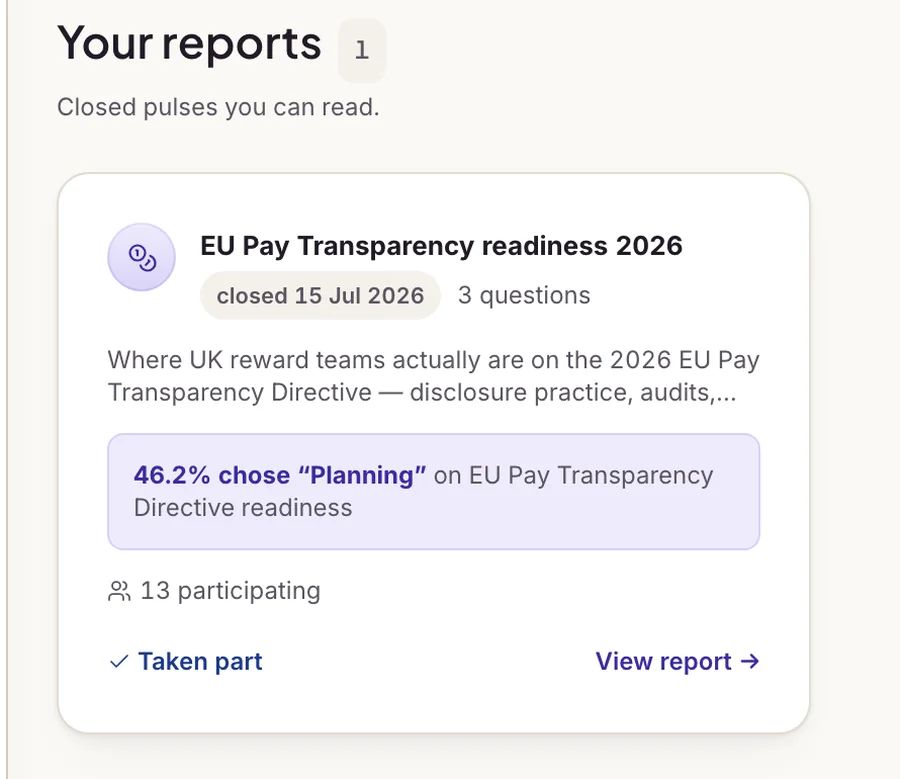
Ask the community.
When nobody has the data yet, a Pulse puts the question to members and shares what comes back.
Ask the community.
Some questions aren’t in any survey yet. Are peers paying a cost-of-living supplement this year? Who’s changed their hybrid policy since the last one? What’s the going rate on a long-service award nobody’s benchmarked?
A Pulse is a short, time-boxed question to the membership. You bring the question, lumi runs it, members opt in, and everyone who answers sees the result. Same rule as everything else: nothing shown below five organisations.
If the question turns out to matter, it graduates into the core at the next release and gets benchmarked for good.
One Pulse launch is included in membership. Further launches are credited separately.
Pulse results are reported on their own cohort and never pooled into the core benchmark.
Three days you can picture.
Tuesday, 3pm. The CFO asks if your sick pay is competitive.
You pull it up: 44% of contributing organisations offer statutory sick pay only, you said you wanted to be at market on protection, and here is what it costs. Four minutes, and you didn’t ask anyone.
44% statutory sick pay only · the rest enhance in some form lumi benchmark · n=258 · August 2026A Thursday you weren’t expecting.
An email says peers have moved on parental leave and you haven’t, evidence attached. From lumi, not from an exit interview.
March. The board wants the reward strategy.
No weekend lost. In place since January, cited on every figure, gaps and actions already in it. No pyramid.
See a sample board pack (opens in a new tab) Download it as a PDF
You won’t need us in the room.
Your first submission is the hard one. Not the clicking — the deciding. What is reward for here? Where do you lead, where is market fine, where are you not competing? What does your sick pay policy actually say once you’ve read it?
So the deciding is built into the questionnaire. Every section opens with a short clip — what this section is asking, what good looks like, and the one judgement call people get stuck on — sitting where you are at the moment you need it, rather than in a tour you sat through a fortnight ago and can’t find again.
Four stages, in your own time. Set the context first, then bring in the market, then read the signals — and then it keeps watching. You end with a submission, a position and a board pack.
It’s built to not need us. Which means it shouldn’t need us at the start either.
- 1Set the context
- 2Bring in the market
- 3Read the signals
- 4Then it keeps watching
Four stages, self-servedyour first board pack the same daythen it runs itself
Asked and answered.
Stage one — the strategy
What if we haven’t got a reward strategy written down?
Most people haven’t, and most that exist have a pyramid on them. Writing it is stage one, and we do it with you in the first session.
Stage two — your data
How long does the questionnaire take, and do we have to finish it?
About an hour. Most questions are one click, “not applicable” counts, and you can stop and come back — your first answer produces a comparison immediately.
Do we need to integrate anything?
No. It’s a guided questionnaire, and we benchmark policies rather than employee records — so no HRIS integration, and far less for IT to review.
Stage three — the benchmark
Where does the data come from?
The reward data of UK organisations that shared it with us directly, quality-assured against our anchor register of graded published UK sources. As members join, their answers join the same pool. Nothing is scraped and nothing is bought.
Can other members see our data?
No. Members see anonymised aggregates only — medians and distributions. When fewer than five organisations answered a question, the whole card is hidden, and your raw submissions are never exposed. Your data protection team can read exactly what we collect, and why, on our data protection page.
Why is it a community and not a subscription?
Because the data doesn’t exist unless members put it in. Every member contributes, and the pool is the product.
Stages four and five — the plan, and the watching
How do the signals decide what to tell us?
A signal fires when something crosses a threshold: your percentile moves band, or a gap to the market widens. They are ranked by distance from what you said you wanted.
Commercial
How is this different from a survey or a consulting engagement?
A survey is a snapshot in one peer cut, delivered months later as a PDF. lumi starts from your strategy and recomputes whenever a member's data lands, so your position is current every time you open it.
Do you benchmark salaries?
No, deliberately. lumi benchmarks the rest of reward — benefits, time off, pension, wellbeing, recognition and pay practice. It runs alongside the salary survey you already have. Where a sector has no usable pay survey to sit alongside, building one is consultancy work, not part of the platform.
We are a group with several businesses. Is that one membership?
Yes. Each business becomes a unit of your membership, with its own reward data, its own peer group and its own benchmark, and your team switches between them from one login. Units are never counted as each other's peers. Up to five are included; if you have more, tell us.
What happens to our data if lumi goes away?
Export it any time — every benchmark, register and document downloads as CSV, Excel or PDF. Never sold, never used to train AI models.
Start on the rest.
Or take the real thing away: an example board pack (PDF, 11pp) · an example reward strategy & plan (PDF, 40pp)
Prefer email? hello@lumihr.co.uk